
⚡ Parabolic Trough Collector (PTC) System
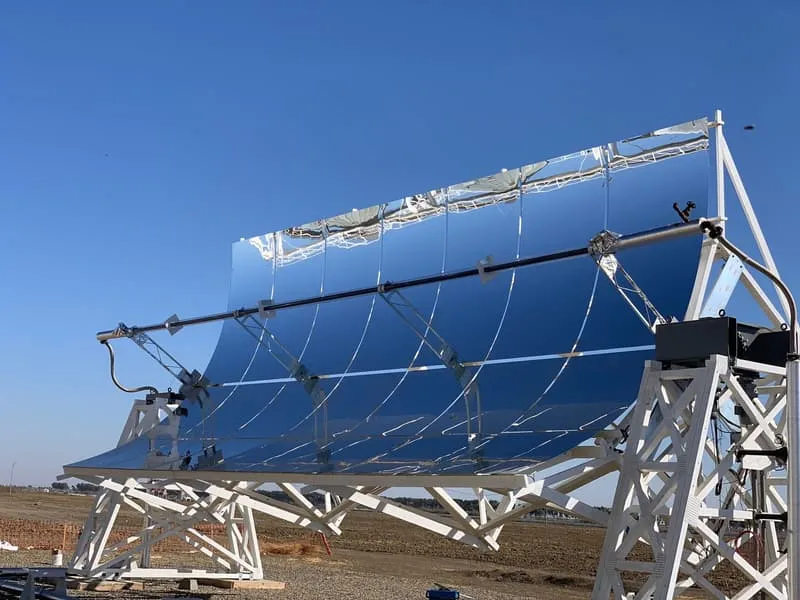
The Parabolic Trough Collector (PTC) System is an advanced concentrated solar thermal (CST) solution engineered for medium to high-temperature industrial process heating. The system uses precision-shaped parabolic reflectors to focus solar radiation onto a linear receiver tube, enabling efficient heat generation for steam, hot water, or thermic fluid applications.
Designed for seamless integration with existing infrastructure, the PTC system enables industries to reduce fossil fuel consumption, stabilize energy costs, and achieve sustainability targets without compromising process reliability.
Engineering Specifications
| Parameter | Specification |
|---|---|
| Collector Technology | Parabolic Trough Collector (PTC) |
| Aperture Width | 4 – 6 meters (custom engineered) |
| Module Length | 12 – 24 meters |
| Aperture Area | 48 – 144 m² per module |
| Reflector Surface | Silvered Glass Mirrors / Anodized Aluminum |
| Reflectivity | ≥ 93% |
| Structural Material | Mild Steel – Hot Dip Galvanized |
| Tracking Mechanism | Fully Automatic Single Axis (North-South Orientation) |
| Tracking Precision | ±0.1° |
| Concentration Ratio | 20:1 – 80:1 |
| Receiver Configuration | Evacuated Tube / Selective Coated Absorber |
| Coating Type | High Absorptivity, Low Emissivity Selective Coating |
| Heat Transfer Fluid | Thermic Oil / Pressurized Water / Molten Salt (optional) |
| Operating Temperature Range | 120°C – 400°C |
| Design Pressure | As per process requirement (customized) |
Thermal Performance
| Parameter | Value |
|---|---|
| Thermal Output (per module) | 25 kW – 150 kW |
| Optical Efficiency | 70% – 80% |
| Net System Efficiency | 55% – 70% |
| Solar Resource Requirement | DNI ≥ 500 W/m² |
| Daily Operating Window | 6–8 hours (clear sky) |
System Architecture
The PTC system is delivered as a fully integrated thermal solution comprising:
Parabolic Trough Reflector Modules
Linear Receiver Tube Assembly
Automatic Tracking System with PLC
Drive System (motor, gearbox, actuator)
Structural Support & Civil Foundation
Heat Transfer Loop (piping, insulation, valves)
Instrumentation (temp, pressure, flow sensors)
Control Panel & Automation Interface
Optional Thermal Energy Storage (TES)
Process Integration
The system is engineered for flexible integration across industrial utilities:
Integration Solutions
- Boiler Feedwater Preheating
- Direct Steam Generation (DSG)
- Thermic Fluid Heating Systems
- Hybrid with Existing boilers (LPG, Diesel, Biomass)
- Waste Heat Recovery Integration
Industrial Applications
Manufacturing & Processing
- Textile & Dyeing
- Chemical & Petrochemical
- Pharmaceutical
- Paper & Pulp
Food, Dairy & Hospitality
- Food & Agro
- Dairy & Milk
- Hotels & Resorts
- Institutional Kitchens
Safety & Control
The system incorporates industrial-grade safety and control mechanisms:
Automatic Stow Position During High Wind
Over-temperature & Over-pressure Protection
Emergency Shutdown System (Manual + Automatic)
Real-time Monitoring of Thermal Parameters
Sustainability & Financial Impact
Fossil Fuel Reduction
- 30% to 70% reduction
CO₂ Emission Reduction
- 50–500 tons/year (project dependent)
Payback Period
- 2–5 years
System Lifespan
- 20–25 years
Supports ESG compliance and carbon credit generation | Eligible under applicable MNRE solar thermal schemes
Deployment & Maintenance
| Category | Details |
|---|---|
| Installation Timeline | 2 to 6 weeks (based on project scale) |
| Requirements | Civil foundation and alignment required |
| Maintenance | Periodic reflector cleaning for optical efficiency |
| Inspection | Tracking system and actuators |
| Fluid Monitoring | Heat transfer fluid monitoring |
| Preventive | Annual preventive maintenance |
Scalability & Customization
Modular design enables easy capacity expansion
System capacity:
100 kWth to multi-MWth installations
Process Temperature Requirement
Steam Demand Profile
Available Land Area
Solar Resource Conditions
Advanced Add-ons
Thermal Energy Storage
Molten Salt / Pressurized Systems
IoT-enabled Remote Monitoring
& Analytics
AI-based Solar Optimization
& Load Matching
Hybrid Integration
Biomass / Electrical Systems
SCADA-based
Centralized Control
Strategic Advantage of PTC Systems
Key Benefits
- Reliability: High-temperature heat for industrial processes
- Cost-Effective: Significant reduction in operating energy cost
- Proven: Scalable solar thermal technology
- Sustainable: Enhances sustainability credentials and compliance
- Stable: Reduces exposure to fuel price volatility